Natural language → contract → design-rule moat → firmware / sim / PCB.
A pipeline that turns intent into manufacturable hardware.
18 tests pass3 chip variants10 real parts1 round to converge
↓ scroll · walk the whole pipeline
01Natural language
Start from one sentence in your head
$ via new "An ESP32-S3 air-quality monitor: read temperature & humidity from a BME280 over I²C, show readings on a 128×64 OLED on the same I²C bus, a green status LED, a button, and publish over WiFi."
02Contract · source of truth
One contract.yaml derives everything
# grounded LLM · schema check · 1 round
target: { chip: esp32-s3, module: wroom-1-n16r8 }
power: { regulator_ma: 1000, decoupling: ✓ }
nets:
- { i2c0: sda=GPIO8 · scl=GPIO9 }
peripherals: bme280 · oled · status_led(GPIO48) · button(GPIO4)
All three are pure projections — they never drift.
03Design-rule moat
Deterministic linter catches → auto-repairs
Every rule cites an Espressif doc — the safety net above AI generation.
ERRVIA-FLASH-RESERVED[GPIO26] SDA on a SPI-flash-reserved pin
ERRVIA-POWER-CURRENT[power] 3.3V only 250mA < 500mA (WiFi on)
ERRVIA-PIN-CONFLICT[GPIO4] GPIO4 claimed by relay and button
PASS3 errors → 0 errors · 0 warnings · contract clean ✓
04Three projections
One contract fans out into three verifiable artifacts
Circuit
schematic · fab
→ .kicad_pcb · 10 partsFirmware
via_pins.h · platformio
→ firmware.bin · 726KBIn-loop sim
wiring · firmware-in-loop
→ asserts serial ✓05Verified output
real compile · real sim · real board
A replay of a session that actually ran — real compile, real sim, real orderable board.
via · live replay
via new "ESP32-S3 air monitor · BME280 · OLED · WiFi telemetry"grounded gen (claude-opus-4-8) → schema check → design-rule lintconverged: True · rounds: 1 · contract clean ✓via build air-monitor[firmware] firmware.bin 726KB · RAM 13.4% · Flash 21.7% ✓[sim] IRQ → ISR → semaphore → chip id 0x60 ✓[circuit] auto-pick 10/10 → default.kicad_pcb · orderable BOM ✓done — natural language → a manufacturable board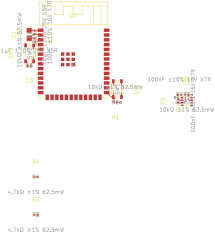
real artifact · actual PCB56.8 × 61.7 mm
| Ref | Part | LCSC |
|---|---|---|
| U1 | ESP32-S3-WROOM-1-N16R8 | C2913202 |
| U2 | Bosch BME280 | C92489 |
| R3,R4 | 4.7kΩ · I²C pull-ups | C25900 |
06Self-hosted core
We even build the simulator ourselves
01
Register-accurate C3 I²C controller
command-list engine · real ESP-IDF register map
02
Real async interrupts + a minimal RTOS
Unicorn preempts → vectors to ISR · semaphore wake
03
Reads chip id 0x60
real RISC-V exec → MMIO intercept → device model
07Loop closed
Natural language
→ a manufacturable board
NL→contract→lint→circuit · firmware · sim→PCB
ESP32-S3 / C3 / classic · 18 tests pass · verified end-to-end on real hardware.
via — natural language to verified hardware